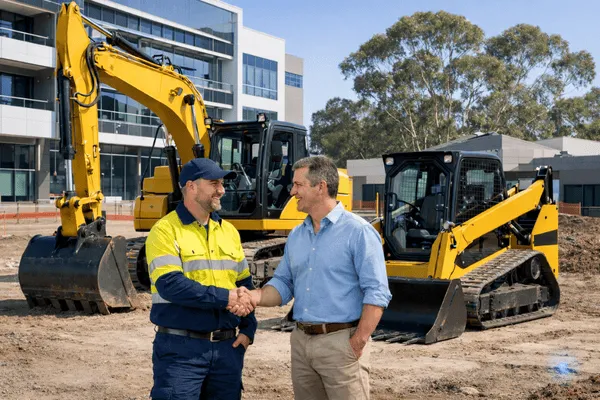
Equipment & Machinery Finance Australia – Complete Guide for ABN Holders
If your business relies on plant, machinery or equipment to complete work, the way you finance those assets is very different to a personal loan.
Lenders assess equipment finance for ABN holders as commercial lending, focusing on business activity and bank statements rather than payslips. Excavators, skid steers, loaders, tractors and other machinery are viewed as income-producing assets.
This complete guide explains how equipment and machinery finance works in Australia, what lenders look for, how repayments are structured, and how to prepare for fast approval.
If you’re also financing vehicles and trucks for the same business, you’ll want to read our other hubs too: Business Vehicle Finance for ABN Holders – Complete Guide and Truck Finance Australia – Complete Guide.
Who This Guide Is For
This guide is for Australian businesses purchasing equipment for work, including:
Earthmoving contractors buying excavators, skid steers, loaders and attachments
Builders and construction businesses bringing plant in-house to reduce hire costs
Landscapers and civil operators expanding capacity to take on larger jobs
Farmers and agricultural operators upgrading tractors and farm machinery
Trades and service businesses purchasing specialised equipment required to deliver services
Growing businesses hiring staff and needing additional machines to meet demand
It applies whether you’re a sole trader, partnership, company or trust — if the asset is used to generate business income, the lending approach is commercial.
What “Equipment & Machinery Finance” Actually Means
Equipment finance is simply a structured way to purchase (or upgrade) business assets without paying the full amount upfront.
Instead of tying up a large amount of cash in one hit, the business spreads the cost of the machine over the period it earns income. This is why equipment finance is so common in industries where machinery directly drives revenue.
In plain terms, lenders are asking:
Does the business appear to be genuinely trading?
Does the machine fit the type of work?
Can the repayments be covered by real cash flow?
Is the asset a reasonable commercial risk (age, type, condition)?
When the answers are clear, approvals can be surprisingly straightforward.
Equipment Types Commonly Financed in Australia
Lenders are generally comfortable funding a wide range of plant and machinery, including:
Earthmoving and construction plant
Excavators, skid steers, loaders, backhoes, track loaders, dozers (case-by-case), graders (case-by-case), compactors/rollers, and more.
Access and lifting equipment
Scissor lifts, EWPs/boom lifts, telehandlers, forklifts.
Agricultural machinery
Tractors, harvest-related machinery (case-by-case), implements and attachments.
Trade and specialist equipment
Generators, compressors, welding equipment, mobile workshops, and industry-specific machinery where it clearly supports income.
Attachments and fit-outs
Buckets, augers, rock breakers/hammers, pallet forks, trenchers, rakes, slashers, and other attachments are often fundable — particularly when bundled with the machine purchase.
The big idea is this: lenders prefer equipment that has a clear role in producing income and has an established resale market.
Why Equipment Finance Is Often Easier Than People Expect
A common misconception is that machinery finance requires years of financial statements and a complex approval process.
In reality, many lenders can assess equipment finance using recent bank statements and basic business information — because for machinery lending, what matters most is current trading activity and whether the asset matches the work.
This is especially true for:
established tradies and contractors
businesses with consistent deposits
operators replacing hire equipment with owned equipment
businesses upgrading to reduce downtime
When the story is clear, the lender doesn’t need to “guess” — and that’s what speeds approvals up.
What Lenders Look For in Equipment Finance Applications
This is where most approvals are won or lost — not because your business is “good” or “bad”, but because the application is either clear or messy.
1) ABN and business activity
Lenders want to see that you’re a genuine operating business. If your ABN has been active for a while, you’ll typically have more options — but newer ABNs may still be considered when income is strong and the equipment choice makes sense.
2) GST registration
GST registration often supports the commercial nature of the application and can improve lender confidence. It isn’t always mandatory, but it helps.
3) Bank statements and cash-flow reality
This is usually the biggest factor. Lenders look for:
consistent deposits
evidence of ongoing work
reasonable account conduct
They’re not expecting perfection — they’re looking for evidence your business can carry the repayments while still covering real operating costs.
4) The machine itself
Age, condition, type, brand (sometimes), and whether the machine fits your work type all matter. Equipment outside normal comfort zones can still be possible, but it typically requires stronger supporting information.
5) Credit and conduct
Credit history is considered, but in commercial asset finance, it is often one part of a broader picture. Strong trading activity can outweigh minor issues; unclear conduct plus weak trading is where files struggle.
What Documents Are Typically Required
Many equipment finance applications can start with a clean, simple pack:
Driver licence (and sometimes additional ID)
ABN and GST details
3–6 months business bank statements (complete PDFs, not screenshots)
Equipment quote/invoice/details (make/model/serial where available)
Depending on the scenario, a lender may request additional documents — but the above is the core that allows assessment to begin quickly.
How Repayments Are Structured
Equipment finance is usually structured so the repayment profile matches how the machine earns money.
Typical terms
Often 3 to 7 years, depending on:
the machine’s age
expected useful life
business cash flow
desired repayment level
Balloon payments
Many businesses choose a balloon (a lump sum at the end) to keep regular repayments lower.
This is common because:
machines often hold resale value
operators upgrade as the business scales
lower repayments preserve working capital
At the end of term, the balloon can typically be:
paid out
refinanced
cleared via sale/trade-in
A balloon isn’t “good” or “bad” — it’s a cash-flow tool. The key is choosing a balloon level that matches a realistic exit plan.
New vs Used Equipment
Both new and used machinery is financed constantly in Australia.
New equipment
New machines generally have clearer documentation, predictable condition, and often smoother settlement processes. This can reduce back-and-forth and speed up approvals.
Used equipment
Used machinery is extremely common — particularly for earthmoving and trade businesses. Lenders usually focus more on:
age at the end of the term
condition and suitability
clear purchase details
Used equipment isn’t a problem. Messy details are what cause delays.
Dealer Purchase vs Private Sale vs Auction
Where the machine comes from affects how clean the paperwork is — and paperwork affects speed.
Dealer / vendor purchase
Often fastest because invoices are standard and asset details are clear.
Private sale
Often possible, but needs clear information (ownership details, machine identifiers, condition clarity). Private sales become slow when the lender can’t verify details easily.
Auctions
Auctions can be financeable, but the key risk is timing. Auctions move fast and you don’t want to win a machine without having your finance pathway clear.
If speed matters, the best strategy is to confirm your likely finance range before committing to a purchase method that has tight timelines.
Is Zero Deposit Equipment Finance Possible?
Often, yes.
Many lenders will fund:
100% of the machine price
and sometimes additional costs (delivery, setup, attachments), depending on the deal
Zero deposit is common when:
the business has consistent bank statement income
the equipment choice is sensible
the overall file is clean and well presented
A deposit may be required when:
the ABN is very new
income is inconsistent or hard to follow
the machine is outside standard guidelines (very old/unusual)
Low Doc Equipment Finance
“Low doc” in equipment lending doesn’t mean “no proof”. It typically means the lender can assess the file primarily using:
bank statements
ABN/GST details
and the equipment information
This is useful when:
financials aren’t up to date
the business has strong current cash flow
the operator needs a machine quickly to take on work
Low doc is common in the real world because the lender can often see trading activity more clearly in current statements than in older financials.
Hire vs Buy vs Finance
This is one of the most important “buyer-ready” decisions in equipment.
When hire makes sense
Hiring can suit short-term needs, unusual equipment used rarely, or when job volume is uncertain.
When buying/financing makes sense
Financing often makes sense when:
the machine will be used regularly
hire costs are materially impacting profit
you want certainty and availability
you want to scale capacity
Many businesses finance equipment specifically to stop bleeding margin through long-term hire.
A common real-world example: a landscaping business hires a skid steer repeatedly over months. At some point, the hire cost starts to look like ownership without the benefits. Financing converts that ongoing expense into ownership of an income-producing asset.
Real-World Scenarios Lenders See Every Day
Equipment lending is full of everyday business growth stories. For example:
Earthmoving contractor expanding capacity
You’ve got steady work, the phone keeps ringing, and the bottleneck is machine availability. A second excavator or skid steer allows you to take on more jobs without waiting.
Builder bringing plant in-house
Hiring equipment works until it doesn’t — availability issues and ongoing costs start hurting profit. Financing equipment can reduce reliance on hire and keep projects moving.
Landscaper upgrading from small to larger machinery
The business grows from small residential work into larger commercial jobs. Bigger machinery increases efficiency and revenue per day — if repayments are structured sensibly.
Farmer upgrading machinery ahead of season
Timing matters in agriculture. Finance can allow machinery upgrades without draining cash reserves needed for operations.
These are not unusual deals to lenders — they’re standard commercial asset use cases.
Common Mistakes That Delay Equipment Approvals
Most delays are process problems, not business problems.
Incomplete bank statements
Missing pages cause immediate follow-up requests. Complete PDFs matter.
Unclear machine details
If the lender can’t clearly identify what you’re buying, they pause. Clear make/model/year/serial (where possible) and a proper invoice reduces delays.
Choosing equipment outside comfort zones without guidance
Very old machines, unusual assets, or unclear use-case purchases can trigger additional questions. A quick check before committing can save a lot of time.
Committing to purchase before finance clarity
Paying deposits and signing agreements before confirming the finance pathway creates stress and time pressure. Pre-approval or a quick “feasibility check” avoids this.
How to Prepare for a 24–48 Hour Approval
When approvals happen fast, it’s usually because the lender has everything needed to make a decision without guessing.
A strong fast-approval pack typically includes:
ID
ABN/GST details
complete bank statement PDFs
clear equipment invoice/details
a short explanation of what the machine will be used for
That last point matters more than people realise. A single sentence like “skid steer for landscaping and site prep work” or “excavator for residential earthworks contracts” can remove ambiguity.
FAQs
Can I finance used equipment?
Yes — used machinery finance is very common, as long as the asset meets age and condition guidelines.
Can I finance equipment from a private seller?
Often yes, provided the purchase details are clear and the lender can verify the asset.
Do I need tax returns?
Often no. Many applications are assessed using bank statements, especially for low doc pathways.
How long can the loan term be?
Commonly up to 7 years, depending on equipment type and age.
Can I include attachments in the finance?
Often yes, particularly if they are purchased with the machine and clearly listed on the invoice.
Is zero deposit possible?
Often yes, depending on trading strength and the asset.
Can I refinance existing equipment?
In many cases, yes — especially when it improves cash flow or consolidates facilities.
Is equipment finance available Australia wide?
Yes — equipment finance is commonly arranged Australia wide, including regional areas.
Will lenders finance “yellow gear” specifically?
Often yes. Excavators, skid steers and loaders are common commercial assets with established resale markets.
Does the machine brand matter?
Sometimes. Popular brands with strong resale may be simpler, but brand alone rarely decides approval.
What if my ABN is under 12 months?
Options may still exist if income is consistent and the asset clearly supports the work. The application just needs to be presented cleanly.
Can I get approval before I buy?
Yes — and it’s often the smartest way to shop confidently and avoid delays.
Final Thoughts
Plant and machinery are core tools for many Australian businesses, and equipment finance is designed to help you acquire those assets without draining working capital. When the machine clearly supports your work and your bank statements show real trading activity, approvals can be quicker and more flexible than expected.
Understanding the lending framework before you commit to a purchase can help you structure repayments sensibly and avoid unnecessary delays.
If you’re also financing trucks or business vehicles, you may find these guides helpful:
Truck Finance Australia – Complete Guide
Business Vehicle Finance for ABN Holders – Complete Guide

